Tuesday, March 5, 2013

Ni no Kuni - Wrath of the White Witch Review


With games like the Dark Cloud duology, Dragon Quest VIII / IX and the Professor Layton series, Level-5 have established themselves as one of the most talented game developers of our time. They always put a lot of love and thought into their games and it always shows. The Lead Designer, President and CEO of the company, Akihiro Hino, is a huge Studio Ghibli fan and always wanted to make a game with them. It wasn't easy, though, since one of the co-owners, Hayao Miyazaki, doesn't like video games. One day, however, Mr. Hino and his staff went to Studio Ghibli to give everybody there a presentation on what kind of story they wanted to tell, and about the otherworldly feel they wanted the world of the game to have. Impressed by how much passion Mr. Hino felt for his work, Miyazaki decided to allow this once in a lifetime collaboration. Ni no Kuni is a love letter to traditional JRPGs from the golden age. Let's take a look:


The Story:

This game tells the story of a young and innocent boy called Oliver, who finds a magic being called Drippy that helps him open a portal into another world so they can search for something very dear to him. The story is wonderful, masterfully balancing humor and drama thanks to great writing. All the characters have very strong personalities and a lot of charm. As is the norm for a Level-5 game, Ni no Kuni has a very charming sense of humor that cleverly uses plays on words and character traits to get laughs. Throughout the game you'll learn more and more about this new world and the secrets of the people orchestrating its demise. Every sub-plot has a great payoff resulting in an incredibly satisfying narrative.

Overall it's a fantastic story with fantastic characters.

10/10


The Gameplay:

Ni no Kuni is an homage to various famous JRPG franchises. It has the large and explorable world map from classic FF games, a combat system that mixes FFXII with Tales and a  monster-catching mechanic reminiscent of Pokémon. One of its noteworthy unique mechanics, however, is a magical locket. In this world, the villains, in order to keep people from defying them, remove certain emotions from people's hearts, leaving them completely unlike themselves. It's your job to save the people by taking bits of a certain emotion from a person who has it in abundance and giving it to people lacking it in order to restore them to their properselves. This will happen not just in the main story, but in side-quests, too, and it's the primary way of interacting with the people of this world. Speaking of side-quests, they're numerous and very rewarding, as they present you with great items, alchemy formulas and money. One in particular, in which you help the ghost of a dead wizard find out who he was in life, is very satisfying.

But the most well designed aspect of the game might just be the combat system. When you find a monster on the field, you enter into a 3D battle area where you can move freely and run from incoming attacks in Tales style and select your action commands in real-time. Cycling through the menus, however, stops the action like in the old school ATB system from classic FF games. What really makes the combat system great is its philosophy of rewarding and punishing players depending on how well they play. Everytime you use the "Defend" command to block any incoming attack, the enemy drops HP and MP recovery orbs. Exploiting elemental weaknesses deals more damage, and using specific strategies that depend on which enemy you're facing can stun it so that you get time to heal or attack even more. Every time you sucessfully perform one of these tasks, you increase the chance of a golden orb appearing on the field, which unlocks a special attack that deals massive damage. So to sum up: The brilliant combat system punishes players who try to brutally force their way through the game with longer battles, but rewards methodical players by making their lives easier.

The only real gameplay issue I can find is that catching monsters is for the most part luck-based, which makes catching specific monsters you might want more of a hassle than it needs to be. Fortunately,the game doesn't require that you catch more than just a few of them, so it doesn't hurt the experience.

Overall the gameplay is excellent. It's diverse and has a ton of depth while remaining user-friendly.

9.5/10


The Audio:

Studio Ghibli contacted renowned Japanese composer Joe Hisaishi (Known for making music for all of Hayao Miyazaki's movies) to consider working on the game. After also being impressed by how much passion Level-5 had for this project, he decided to accept. Every track in this game is catchy, epic, powerful and always fits the situation it's used in. The music was performed by the famous Tokyo Philharmonic Orchestra and it sounds absolutely wonderful. The vocal theme, "Pieces of a Broken Heart", is performed by the composer's daugher Mai in the Japanese version, and Archie Buchanan in the English version. Both of them sound absolutely beautiful. The voice acting is also exceptionally well done. Every actor handles both comedy relief and dramatic moments very well.

10/10


The Graphics:

Studio Ghibli working on the visuals of a video game is basically the dream of anyone who loves animation and gaming. Well, we can stop dreaming, because it's true. The hand made FMV cut-scenes look exactly like they were taken from one of their movies. The in-game cutscenes also look absolutely gorgeous, making the best use of cel-shaded graphics since Wind Waker. As usual with Level-5, there's an incredible attention to detail with character animations, graphical effects and backgrounds, which are absolutely filled with pretty things to look at. Character design is also very Ghibli-esque and monster design is the best I've ever seen. Every monster in this game is charming, cute or just cool looking, which makes it hard to resist capturing them for your party.

10/10


Ni no Kuni is a masterpiece. It's the wonderful result of a collaboration between two studios that are absolute masters in their field of work. If you have ever enjoyed a JRPG in your life, give this game a chance. You'll be doing yourself a massive disservice if you don't.

Final Grade: 10/10


Thank you Level-5 for this wonderful game :)

Wednesday, February 13, 2013

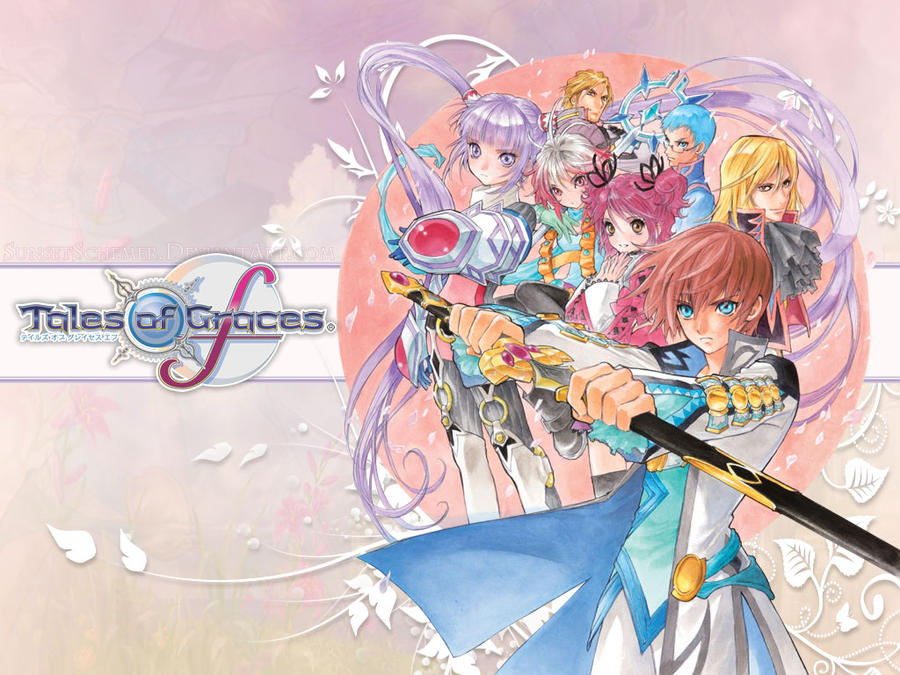
Tales of Graces f Review


Ah the Tales series. This a series that you either love or hate. The Namco Tales studio made a career out of keeping old school JRPG tropes alive, as the series never really strayed away from its roots and its trademark anime look and tone. I love most of the games and those that i don't love i just like, so yeah, call me a fan of the series. Before this game came out games were being developed by 2 separate teams, which are known to fans as Team Symphonia(They make the larger scale games) and Team Destiny(Smaller scale games). In recent years though, Hideo Baba became producer of the series and a new policy was implemented: The 2 teams now work together to assure games of higher quality, even though the team behind the original idea of each game still makes the major decisions to keep artistic vision intact and keep the games with enough distinct differences. The game we're looking at today was developed with Team Destiny calling the shots, and it was originally a Wii game in Japan, but because of serious bugs, the Wii version was discontinued and the game was ported to the PS3, with better graphics and extra content, including a new story chapter and some new music.
Hideo Baba's role as producer so far looks like a great idea, as the first game in this new era of the series is the best since Tales of the Abyss. Let's take a look:


The Story:

This game tells the story of a young boy named Asbel Lhant. While playing in a hill outside his hometown with his brother, he finds a weird girl in a meadow with amnesia. With the help of his friends and family, Asbel starts investigating the mystery of who she is and where she came from, with tragic consequences that will forever change their lives. This game has the first great story of the series in a while. It's for the most part a tale of friendship, with elements of resentment, redemption, young love and the value of life to mix things up. For the most part the script is great, filled with humor and honest tenderness, even if there's still the occasional cringeworthy lines that plagued the least good games in the series. As always there are skits(Optional conversations between characters triggered by the Select button) and the skits in Graces are by far the best the series has ever had, as they range from mildly entertaining to wildly funny or sincerely sad. The big strength of the story however are the characters. All of them have strong personalities, and are very well developed, except for one, who despite being really funny, doesn't go through enough development to make her a fully realized character. Also the first ending of the game, which was the definite ending in the Wii original, is kinda lackluster. It's not bad, but it leaves some subplots unresolved and the final cutscene before the credits is worthy of a facepalm because of how corny it is. Fortunately the developers added an extra story chapter in the PS3 port that solves all those problems and gives us a far better ending that ties all the loose ends in a satisfying way.

Overall it's a great story with great characters.

8/10


The Gameplay:

As the first game in this new era of Tales games, Graces makes some noticeable changes to the gameplay formula. The combat system in particular is the first in a 3D Tales to not be a refined version of the Symphonia battle system. It's still essentially the same action based combat where you fight in a 3D area everytime you touch a monster and perform physical attacks and fighting and healing abilities called Artes while dodging enemy attacks. One of the major differences is that Technique points(This series equivalent of MP) was replaced by Chain Capacity points. Almost every action you perform costs a few CC, even physical attacks. However, characters are always regaining CC points when they are not doing anything that requires points. This obviously means there are no orange gels in this game. CC points make combat much more intuitive and fast paced, as you won't need to stop and go to the combat menu to use items to recover mana. Depth was not sacrificed though, as you'll need to use CC cleverly if you want to keep combos going and cause massive damage, which is essential against tough opponents. Another major difference is how this time there are 2 types of artes: B-Artes and A-Artes. B-Artes are performed by using the button inputs they're mapped to, like in previous games, but while performing these you can extend you attack combo by following it with an A-Arte if you have enough CC. Some enemies are weaker to a specific type of Arte, so good choices of which Artes to use is essential. The Over Limit(Unison in the Symphonia games) gauge that in the previous games allowed you to perform powerful Mystic Artes when full was replaced by the Eleth gauge. There's 2 sections of the gauge, every time you attack an enemy sucessfully or guard/dodge an attack the blue section fills a bit. It also works in vice-versa for the orange section. Depending on which section gets full, you or the enemies will go into an "Eleth Break" mode for a few seconds where CC is unlimited and you can perform Mystic Artes, powerful attacks that cause massive damage. This adds alot of strategy to the combat, since it forces you to constantly think about your strategy to avoid being on the receiving end of a Mystic Arte.The traditional title system from previous games where characters gain certain titles that affect their stats in some way(Except in Vesperia, where titles were useless for some reason), is in this game the first new character development system of the series since Symphonia. Every character in this game can gain titles through side-quests, story events, and mostly by fighting battles and they can get around 200 titles, the biggest selection in the series thus far. Every title has a particular effect on the character when equipped just like older games, but by gaining Skill points at the end of every battle, you can learn a total of 5 skills from each title which range from stat bonuses to Mystic Artes. It's the primary way of making characters stronger and it's recommended you check which title gives what so you can learn the more useful skills as early as possible if you want to stand a chance in the toughest battles of the game.

The overworld while containing a lot of towns, dungeons etc., has a linear structure that resembles FFX(Probably because of the original game being limited by the small space of the single-layer DVD), despite being much better executed. One of the main strengths of the gameplay are the side-quests. Every side-quest tells a story that ranges from entertainingly funny to heartbreakingly sad and even dark. They develop the main characters further and flesh out some minor characters, making them very rewarding. A lot of love and care went into creating the world of this game and it shows.

Overall, the gameplay is fantastic. It excels at literally everything it does.

9/10


The Audio:

Just like every other Tales game, the music is composed by Motoi Sakuraba, veteran RPG composer that recently gave us fantastic music in Kid Icarus: Uprising and Dark Souls. His music for this series tends to sound bland to me most of the time though. Symphonia and Abyss had great soundtracks, but after that he just seems to go on autopilot when he does music for a Tales game. In this particular game i can only recall the wonderful main theme and its variations(Not the vocal version though, that's terrible), the cool battle themes and a few nice town and overworld themes. Most of the soundtrack, despite being well composed is just not all that memorable, it's just JRPG generic soundtrack. Personally I think it's time Sakuraba does what Koji Kondo did and just be a sound director, so some new composer can be brought in to bring much needed life into the music of this series. The voice acting is overall stellar. Every actor does a fantastic job of giving life to the characters, especially experienced anime VA Cassandra Morris in her first VG role as Sophie.

6.5/10


The Graphics:

Since this is an HD port of a Wii game, the graphics obviously aren't up to par with other PS3 games. I have to say though, these are some of the best graphics I've seen in a Wii game. The animations, while not stellar, are very well done and do a great job of expressing the character's emotions. The textures despite its standard definition roots come across nice-looking in this HD port. The character design by veteran Tales artist Mutsumi Inomata gives the characters a lot of charm. The monster design is also very good. This game may have not have had many resources, but the artists did the best with what they had.

8/10


Overall, Tales of Graces f is a great game that captures what makes this genre great when developers know what they're doing. It's not groundbreaking and the formula is still essentially the same, but this game proves that radical rethinking isn't always necessary for a series to retain its quality. Graces stands as a great example of how you can take old conventions and still make a great game if you put a lot of heart and thought into it. The story is very well told, the gameplay never gets dull and the visuals, while simple, are still charming. It won't blow you away, but if you give it a chance, it might remind you of what makes old school JRPGs so endearing.

Final Grade: 8/10


All i can say is well done Tales Studio, and now bring on Tales of Xillia. Join me next time when i review Ni no Kuni: Wrath of the White Witch. See ya then ;)

Tuesday, September 25, 2012

The World Ends With You Review


During Kingdom Hearts II's development, Tetsuya Nomura was approached by Square to create a game specifically for the Nintendo DS. He and his team got to talking about it and imagined a game that would use all of the DS's capabilities. Inspired by the Shin Megami Tensei series, they decided to make a game fueled by Japanese culture. After two years and a half in development, "The World Ends With You" was released to critical acclaim. It doesn't have many fans but the small fanbase is very passionate about it.  Let's take a look:


The Story:

This game tells a modern Sci-Fi fantasy story of a boy born and raised in Shibuya named Neku who one day wakes up in the middle of a street with no memory of how he got there or who he even is. He notices that no one can see or hear him so he has to figure it out alone and gets attacked by monsters. He's forced to partner with a girl he meets in order to survive this mysterious world, and figure out what's going on and how to get back home.  This game has an absolutely wonderful story. It explores various themes like overcoming your own internal fears and looking beyond the obvious to discover great stuff about the world. It's extremely well written and has surprisingly complex and compelling characters.

Overall it's a fantastic story with wonderful characters.

10/10


The Gameplay:

This game has a somewhat linear nature since you won't always be able to go anywhere in the city, but it's not like in games like FFXIII where you just walk in hallways. What helps in making the player care about saving Shibuya is an ability Neku has to read the thoughts of everybody in Shibuya. Through this mechanic, you get to learn about them, their dreams and ambitions, which compliments the story beautifully. Not since FFVI has Square made a game with story and gameplay complimenting each other so well. By the time this game was over i was incredibly happy i saved the city.

The game is divided in 3 chapters, each chronicling a week storywise. Each day of the week you get a specific mission that can vary from fighting a monster to solving a puzzle. You go through the city fighting monsters and the villain characters until the 3 weeks are over.

What really makes this game unique is the combat system. Combat takes full advantage of the DS's capabilities. Neku fights in the bottom screen and his partner fights in the top screen. The partner is controlled by the buttons and you take actions playing a card game mechanic. Some players might find overwhelming to do this while controlling Neku but the developers thought of that, as you can put the partner in Auto-Play so you can just focus on Neku. Neku is controlled via the touch screen using various offensive and defensive abilities that are executed by using the stylus in various ways like sliding it across the screen to burn monsters or blowing into the mic to create shockwaves.
The abilities you have during combat depend on which pins Neku has equipped which brings me to the development system.

Taking a cue from FFVII, Neku can equip various kinds of pins that you get from battles or shops. They work like the materia system. Each pin has a category and a specific combat ability that becomes usable when equipped. After each battle you get Pin Points which makes pins stronger and eventually makes them evolve into stronger versions. Combining different pins for different situations is key in getting through the game, as the battles can get pretty tough. The Pin system is great, as it allows for alot of customization which of course encourages the player to be strategic in the way he/she plays.

My only problem with the gameplay is again the tacked on minigame "Tin Pin Slammer". I just don't get why Square always feels the need to put these minigames that have nothing to do with the core gameplay of the game. It's basically a Beyblade ripoff except you use pins. It's not bad, but like Triple Triad and Tetra Master, it adds nothing to the game. Fortunately it's completely optional as you don't really need to win any matches to move through the story.

Despite that, the gameplay is excellent. It's unique, fast, strategic and customizable to the player's comfort level.

9.5/10


The Audio:

Because the game draws a lot from Japanese culture, the composer from Dissidia and the Compilation of FFVII Takeharu Ishimoto went for a JPop style. I'm not exactly a fan of this kind of music, but i have to admit, after listening to these tracks for hours they grew on me and i found myself bopping my head to the nice rhytm they have and singing along with the vocals. This OST is not for everyone, but it definitely matches the world and setting of the game. The voice acting, while minimal, is excellent, specially in the movie sequences. The actors do a fantastic job of breathing life into the characters.

8/10


The Graphics:

The visual presentation is absolutely phenomenal as expected from a Square Enix game. The artists used hand drawn sprite animations to get around the DS's limits and still create what is in my opinion the best looking game on the platform. At times it really feels like you're watching an anime. The world of this game is just brimming with life and character thanks to the amazing attention to detail of the artists. Speaking of the artists, Tetsuya Nomura is of course our character designer, and this time he's joined by Gen Kobayashi, who did character designs in remakes of older FF games. Their character and monster designs are fantastic and very creative.

10/10

Overall this is an excellent game with an amazing story, unique gameplay and wonderful presentation.

Final Grade: 9.3/10

Saturday, September 8, 2012

Final Fantasy 25th Anniversary Reviews: Final Fantasy XIII


If you don't know the rules of these reviews please read this first.


After FFXII was finished, Kitase gave control of the next game to Toriyama and his FFX team. After 4 years of hype FFXIII was released to very mixed reactions. This game is without a doubt the less FFish game of the series. I would like to note that the version I'm reviewing is the PS3 version, since this is the one the developers wanted people to play. After all the game was developed as a PS3 exclusive for most of the development cycle. Let's get this over with:


The Story:

This game uses the "Rebels vs. Empire" story formula, but it tweaks it a bit. It tells the story of six people who are cursed by these godlike entities called Fal'Cie (This game's empire) to a fate worst than death: Either do the task the Fal'Cie gave them (and turn into crystal afterwards) or turn into mindless monsters. They start a journey to try to find a way to save themselves and eventually take out these evil entities.

The story, while not flat out terrible, has two major problems that ruin it for me: Unclear plot points and flat character development.  A lot of times in the story, I found myself confused by what happened in the cutscenes because they don't explain things in enough detail. Even Square must have realized this, since this game has a datalog. Every plot point, character and location has a wall of text explaining stuff. At the beginning, it helped with the confusion, but as the game goes on, the entries become more redundant. I just don't understand why this story is so poorly told. FFVII had a complex plot, but didn't need a datalog. The characters aren't much better either, mostly because they feel either like rehashes of characters from previous games or potentially good characters that lack full backstories and proper develpment. And then there's Vanille... This character set the feminist movement back 50 years. She's incredibly dumb, has an annoying voice and screams like one of those female characters that are terrified of mice from 1950s comedies. I hate this character.

Overall it's a bad story with lackluster characters.

3.5/10


The Gameplay:

This game takes the linear style from FFX that Toryiama is known for. This time, however, the linearity reaches crazy levels. Seriously, if you thought FFX was linear think again. At least that game had side quests with variety. In this game, the only thing you can do besides walk through hallways and fight monsters is take missions that consist of...fighting more monsters. How am I supposed to be invested in saving a world that feels so dull and empty?

The turn based combat received a major overhaul. Basically, we still have the ATB gauge, but this time we have an auto-battle option that decides your commands for you. True, you can just not use it, but since battles last so long, you start to rely on this option since it works fine. My biggest problem with combat in this game is the Stagger gauge, which in my opinion is the stupidest idea ever put in a JRPG. See, your attacks normally don't really deal much damage, but they fill the enemy's stagger gauge. Eventually, your attacks will fill it and the enemy will enter stagger mode, at which point your attacks actually do a good amount of damage to its life bar. I just cannot for the life of me understand this mechanic. This doesn't add any strategy to combat, all it does is make battles twice as long. Since you will be in combat 80% of the time, it creates a very drawn out and boring gameplay experience. It should also be noted that this game brings back job...err I mean role switching. In fact, most of what you'll be doing in combat is switching roles according to your situation. Among them are Fighter - I mean Commando, Black Mage - I mean Ravager and White Mage - I mean Medic.....Toriyama, are you out to alienate older fans or something? What's with these unecessary changes?  Well, every character can fully develop as various roles which brings me to the development system.

This time around we have the Crystarium. Everytime you finish a battle, you get CP, which you can then use to move from node to node in this poor man's version of the Sphere Grid. Seriously, why make us have to move from node to node if it's incredibly linear and doesn't really give us choices? You literally just pick the role you want to develop and just hold the button and you'll move through the grid, getting bonuses till you run out of CP. If there's no choice, why even make us do this? Why not just have traditional exp development for each role? It would make everything go on quicker and nothing would be lost.


Overall the gameplay is horrible. Painfully linear, boringly drawn out, and again filled with baffling design choices.

2/10


The Audio:

Since this is a Motomu Toriyama game, it was to be expected of him to use his favorite composer, Masashi Hamauzu. I am not a fan of him. His style has always sounded pretty bland to me. The fact that he refuses to use the three iconic tunes of the series doesn't help. The new victory fanfare is particularly terrible. It's so uncatchy and doesn't even sound like a victory fanfare at all. Apart from four tracks, there's not a single one I remember liking. The terrible vocal song is sung by the astonishingly bland voice of Leona Lewis. Really Square? You didn't think the OST was bland enough already?  The voice acting is also pretty dull. The actors don't do a very good job of giving life to the characters. But then again these are some of the best actors in the industry like Troy Baker and Laura Bailley, so I think it's safe to assume it's the fault of the poor script and the sloppy direction.

3/10


The Graphics:

If there's one thing that I can definitely say lived up to the expectations, it was the visual presentation. The graphics in this game take full advantage of the PS3's capabilities to create a gorgeous looking game. Everything in this game is incredibly detailed and feels natural. Tetsuya Nomura also returned to the character design position. After refining his skills with the games he directed/produced, he was able to come back to give us very well designed characters. Monster design in this game is also the best since FFVI. Most monsters look really cool and are very creative.

10/10


Overall, Final Fantasy XIII is a disappointing game. It looks pretty, but pretty graphics can't disguise the rusty storytelling, bland music and boring gameplay underneath.

Final Grade: 4.5/10


Thanks for joining me on this journey through one of gaming's biggest franchises. See you next review ;)

Sunday, August 26, 2012

Final Fantasy 25th Anniversary Reviews: Final Fantasy XII


If you don't know the rules of these reviews please read this first.


After the so called great FFX, Square decided to make a sequel to it and also assembled a new development team to create MMO installments in the series. This lead to FFX-2, which was hated by pretty much everyone, and FFXI, a MMORPG that is still loved by many. What many people didn't know at the time is that these games, along with spinoffs were to tide over the fans while a new game was being developed. Hiroyuki Ito assembled a new team after FFIX to produce a new, ambitious project that would bring the classic FF formula onto the (then) most recent generation of consoles. The game was part of the Ivalice Alliance: a compilation of games with common themes and story elements that take place in the massive world of Ivalice, which has a half modern, half medieval setting akin to Final Fantasy VI. After six years in development, Final Fantasy XII was finally released. It is a very polarizing game among series fans. Most people hate it, but it has its fans, including me. Let's take a look at it shall we?


The Story:

This game brings back a classic FF story formula: "Rebels vs. Empire". It tells the story of a princess named Ashe who has had her husband and father taken from her when her kingdom was invaded by the neighbouring empire of Archadia. Meanwhile, another neighbouring empire, Rozarria, has declared war against Archadia and her kingdom of Dalmasca. The story is good. Not great, but good.  The narrative is pretty basic, but it does what it wants competently. The characters are what keeps it enjoyable. Some characters are better than others, though. Two of them, despite having backstories and reasons for fighting the empire, are there mostly to be used as a frame of reference for the audience when exposition is necessary. Fortunately, the others, mainly the sky pirate Balthier, are very likable and interesting. The ending in particular was very satisfying.

Overall, it's a good story with pretty good characters.

7/10


The Gameplay:

This game takes the classic FF formula and combines it with some MMO characteristics to create an experience with both a classic and a fresh feel to it, which is what i wanted from FFX but never got.
There's no world map, instead we have a huge MMO style massive world that is 100% open for exploration and has a huge amount of cities, optional dungeons, hunting quests and side-quests to find.

First, the good: The combat in this game brings back the ATB gauge for more lively battles, and is integrated into the world of the game, thus removing random encounters and battle screens. Combat still plays like a turn based game, where you assign commands to each character. Most spells, abilities, and other stuff are bought in stores like in the NES era. Because combat doesn't play exactly like the previous games, you will have to assign commands without ever stopping for anything, which is where the Gambit System comes into play. In shops you can get gambits, which assign automated actions for characters when specific situations occur. The most used gambits will of course be "Attack nearby enemies" and "Heal when HP is low", but there are others like casting specific spells or using certain items in even more specific situations. There are nearly milions of customization possibilities in this system, which can help you get through the game with less trouble. In fact, smart players will realize that they can grind without actually playing the game. This will only happen if the player goes out of his/her way to customize the characters that way, so it doesn't intrude on player interactivity. Not to mention that Gambits are completely optional, which will please players that dislike automation. It's a fantastic system and I could talk for hours about its possibilities, but what really makes it shine is that it makes the gameplay customizable to the player's comfort level.

Our character development system this time around is the License Board. Every time you kill a monster, you gain license points, which you can spend to unlock a license in the board. Every spell, weapon and armor piece in this game requires you to have its respective license before being equipped, which will prevent players from getting powerful stuff by going out of their way to get into one of the later shops and getting strong equipment before the story brings them there, thus preventing the possibility of having an overpowered party. The board is non-linear in structure, which means every character can get a license for everything in the game. The recommended procedure, though, is to develop each character depending on which job you want to him/her to have. Each time you unlock a license, one to four new ones will appear on the board, including the next license of its kind, which will allow for linear development, (For example, unlocking a black spell will make the license for another black spell appear) but people like me will be able to give the character a more diverse role in battle. The License Board is by far the best character development system in the series, for it allows absolute control over growth.

Now, the bad: For some reason, the developers thought placing invisible booby traps over the field was a good idea. You can be walking somewhere and all of a sudden you get a notice saying you triggered a trap and receive massive damage or get infected with status effects. It's just as annoying as it seems. I just can't understand why these exist. They don't add in any way to the challenge and don't require any gaming skill to avoid, so why are they even there? You can avoid them by casting the "Float" spell on yourself or equipping a certain accessory that prevents their activation, but come on, the player shouldn't have to deal with this. It's an annoying flaw, pure and simple. Another problem I have is that some dungeons can be painfully long at times, mostly because their puzzles can be unclear because of a lack of useful clues.

Despite these problems the gameplay is still fantastic. It is the ultimate evolution of the classic FF formula with amazing customization.

9/10


The Audio:

This is the first soundtrack in the series to be fully orchestrated and this time around, we have the composers that did the music for all the games from the Ivalice Alliance: Hitoshi Sakimoto, Masaharu Iwata and Hayato Matsuo. Their music is known for its cinematic feel, which helps give the game an epic feel and a great atmosphere. The music is very epic and listening to the three classic tracks in their fully orchestrated form is unbelievably satisfying. My only problem is the small amount of emotional pieces, but that can be blamed on the basic story. The vocal song, though not the best, is very good, even if it doesn't reflect the story or the characters. The voice acting is also incredibly better than the last game. The acting is very good, especially Balthier's actor.

9/10


The Graphics:

This game goes for an old school fantasy look thanks to Ivalice Alliance artists Akihiko Yoshida and Hiroshi Minagawa. The backgrounds look beautifullly detailed and the character design is cool looking if a bit weird at times. Monster design is also very creative and diverse. They may not be the best graphics on the PS2, but it's still gorgeous.

9/10


I personally love this game even if the story kept it from becoming the best game in the series. It's a fantastic game that in my opinion should be a blueprint for future games in the series.

Final Grade: 8.5/10

Join me next time as we take a look into the final game of this series of reviews: Final Fantasy XIII.

Friday, August 17, 2012

Final Fantasy 25th Anniversary Reviews: Final Fantasy X


If you don't know the rules of these reviews please read this first.


Well, here we are guys. The end of an era. In my opinion, this is where the FF series was ruined beyond repair. As always, with a new console generation comes a new era of FF games. Hironobu Sakaguchi was barely involved in development of the tenth game. Yoshinori Kitase had just been promoted to series producer and with that came a new way to run things. Kitase gave Motomu Toriyama (one of the cutscene designers of VII and VIII) the role of director. Toriyama is known nowadays for his controversially linear approach to JRPGs, so with this game came a radical change to the gameplay. I'm just gonna say it right now: I despise this game. I hate the story, I hate the gameplay and I hate how it strays away from what made the series charming to begin with. Let me reply to the negative comments I'm gonna get right now- "Oh come on, the story is so emotional and the gameplay is just a fresh new direction for the series" - No, i'm sorry but i don't see it. Let's get this over with, I don't want to waste more time than I have to with this so called game:


The So Called Story:

This time around we've got the story of a young man named Tidus who after a weird supernatural incident is transported to a world completely different than the one he was in. After meeting certain people that help him out Tidus starts a journey to try to find out about what happened to him.

The story is God-awful. It just is, plain and simple. I'm aware that this one is a fan-favorite. I'm aware that this is one of those sacred things that no one is allowed to dislike without being accused of being overdemanding. So be it. The story in this game is full of plot-holes, it's inconsistent, it's unbelievably drawn-out and is just plain boring and uninteresting. My main problem is that there's no heart to it. There's nothing genuine about it. It's one of those stories that takes every generic JRPG plot element and crams them all together without any care in making it coherent. The characters don't help either. Tidus is very annoying and doesn't get any better as the game goes on. Yuna is just the generic altruistic summoner that sacrifices everything for everyone without thinking twice about it. The rest of the cast is barely worth mentioning since their development is either nonexistent or insignificant.

The only good thing I have to say about it is one of the sub-plots, which is about three characters that lived years before the main plot. The same problem with FFVIII shows up once again. These characters are way more interesting and their story is actually genuinely tragic. Why? Why couldn't the game have been about this story? I felt like Square was trolling me with how I'm missing out on such an interesting story.

If you're reading this and are interested in details about why I didn't like the story, message me on my Youtube account and we'll figure something out.

Overall it's a terrible story with awful characters.

2/10


The So Called Gameplay:

Like I said before, this is a huge departure from the previous games: gone is the world map, gone are the dungeons and gone are the interesting NPCs. The open environments have also been replaced by claustrophobic hallways that completely eliminate one of the key elements of a Final Fantasy game: exploration.  I just don't get why would they do this. This is not innovation or evolution. They're just literally removing one of the main gameplay elements the series was known for. Because of this, the game doesn't even feel like what it says it is: The tenth entry in the main Final Fantasy series. The linearity is fairly well executed on its own merits but it's still very repetitive. Most of the gameplay is comprised of running and battling with an ocasional temple with puzzles as the only attempt at variety. The problem is that these puzzles are very drawn-out and don't have any logic to them. You literally just radomly place spheres in holes till you accidentally solve them. One particular puzzle that takes place in a moving maze is incredibly confusing, drawn-out and boring. I had to take a two day break because it frustrated me so much.

The character development system this time around is the Sphere Grid. I don't really like this system. This is basically the illusion of development control. After each battle, you get ability points and after getting a certain amount of points, the character gains a sphere level which can then be used to move one space in the Grid. Basically, the grid is a giant board full of nodes. Each node has a bonus for your character's stats, like "HP + 200" or "Strength + 4". This would be a great oportunity to give you great control over the character's growth, but there's one huge problem: the characters still have their pre-set stats and jobs. Why would I ever choose to significantly raise the physical strength of a black mage? Besides, the board is incredibly linear. You would think the board would have multiple ways to go, but instead you're just going on a pre-determined path without any deviation. Any alternate paths on the board are locked and can only be unlocked by a "Key Sphere", which brings me to another aspect of the grid: the actual spheres. After each battle, you receive various types of spheres that have to be used to unlock the bonuses from each node. A "Mana Sphere", for example unlocks the bonus from an MP node. There are other spheres that unlock any bonus of a certain kind without the need to move in the grid and even some that allow us to warp to any node instantly. I just don't get this system. Is it driven by choice or is it linear? Half of its elements contradict the other half. I'm sorry, Square, but you either give us control over development or you don't. You can't have it both ways. The only side attraction besides Side-Quests is Blitzball, our minigame this time around. It's boring, it's overly complicated and adds nothing to the game, it's just there.

Fortunately, there are good aspects to the gameplay: the combat is fast-paced, it's a nice throwback to the fully turn-based format from the NES era and a new feature that allows you to switch your party members mid-battle adds some strategy to the battles. Also, the very last puzzle of the game is radically different from the other ones and I found it to be enjoyable. It's not great, but it was a well made enough puzzle.

Despite that, the gameplay is just plain horrible. It doesn't know what it wants to be and lacks fun stuff to do.

3/10


The Audio:

For the first time, Nobuo Uematsu had assistance in composing the music. The new composers are Junya Nakano (Now known for the composition/arrangement of the FFIV saga) and Masashi Hamauzu(Known for being the main composer of the FFXIII trilogy). The soundtrack is pretty mediocre overall. There are a few good tracks, but most of them are forgettable or just plain bad. It should also be noted that this game doesn't have the main Final Fantasy Theme. Why, Nobuo? This is like making a Mario game without the classic Mario theme. You might say it's not important, but I disagree. You don't just ignore traditions like that. This, combined with a very different and mediocre instrumentation, results in a soundtrack that, for the most part, doesn't feel like a Final Fantasy soundtrack. The vocal theme song is just a mediocre and generic anime style song. I should also mention that this was the first game in the series to have voice acting. It's terrible though. Each voice is either bland, boring or annoying. With other games at the time that had much better voice acting, this is just another example of how lazy Square was with this game.

4/10


The So Called Graphics:

This game gets rid of the pre-rendered backgrounds and goes for fully 3d rendered environments to show off the PS2's capabilities, which gives place to some nice looking environments. My huge problem  with the graphics is everything related to the character visuals. The body animations are very weird and consist basically of characters waving their arms awkwardly when they're arguing about something. The facial animations are also very lazy and there was absolutely no lip syncing whatsoever. I don't understand why the animations are so bad. Kingdom Hearts came out around the same time and was vastly superior in all of these areas. Inexcusable. Another thing that really disappointed me in this game was the monster and character design. The monster design, while not exactly bad, is pretty mediocre. Now, the character design is just plain terrible. It reminds me of characters from the Star Wars prequels. Almost every character in this game has impossible physical characteristics and ridiculous clothing, which really pains me to say, because I'm a huge fan of Tetsuya Nomura's character designs. All of these factors make it really hard for me to take the story and characters seriously, because everything looks fake and/or laughable.

5/10

I'm sorry if you think I'm being too harsh with this so called game but i didn't enjoy a single second of it. After FFIX this is an unbelievable disappointment. The story is terrible, the gameplay has an identity crisis and the presentation is really underwhelming.

I recommend everyone who would like a more positive review of the game to check my friend T-Man's review as his is probably the best positive review of this game out there.

Final Grade : 3.5/10

Join me next time as we skip over FFXI for reasons i explained in the rules blogpost which you can find at the top of this review, so we can talk about one of the most controversial games among the fanbase: Final Fantasy XII. See you next time.

Tuesday, August 7, 2012

Final Fantasy 25th Anniversary Reviews: Final Fantasy IX


If you don't know the rules of these reviews please read this first.


While FFVIII was being developed, Sakaguchi assembled a new development team consisting of relatively inexperienced developers to create a game that he wanted to be a love letter to the franchise. A game that would take the best of all the previous games and put it all into one game.
This new team consisted of producer Shinji Hashimoto (Former marketing manager who later on went to produce games developed by this new team, nowadays commonly known as the "Kingdom Hearts Team") and animator Tatsuya Kando (Now known as lead animator of the KH series and creator of "The World Ends With You") among others. FFVI co-director Hiroyuki Ito directed the game and Sakaguchi wrote the story. The result was Final Fantasy IX, a game that has a very passionate fanbase despite its relatively low popularity. Let's look into it shall we? :


The Story:

This game tells the story of a group of thieves that is hired to kidnap a princess. Little do they know that the princess actually wants to get abducted and tries to sneak onto their airship. After escaping her castle, the princess and the thieves start a journey that leads to many adventures that will change them and the world. The story in this game is absolutely fantastic. The themes of love, prejudice, life and purpose are handled masterfully, mainly because of the wonderful characters that manage to be everything that's needed: complex, funny, sympathetic and tragic. The game is also full of big homages and neat easter eggs that reference various games in the series. There's even one part of the story that's clearly a reimagining of part of FFI's story. This is an FF game that loves the series it belongs to.

Overall it's a fantastic story with wonderful characters.

10/10


The Gameplay:

This game brings back the FFIV formula where each character has a single and permanent job according to his/her character. I'm not exactly the biggest fan of this formula, but it's a lot better here since the difficulty is higher than that of VII and VIII, so the lack of control over character growth doesn't bother me. The equipment possibilities have also returned to the FFVI way, so now you have more ways of equipping your character.

First, the good: The only new mechanic is the method of learning abilities. Each piece of equipment has up to three abilities that can be used while the item is equipped. Every ability can be learned by gaining ability points. After that, it can be used without the corresponding item. This mechanic applies to all abilities: spells, supporting abilities, knight techniques etc.
It's a very good system that rewards the player that puts work into the game.

Now, the bad: This game has some frustrating non-optional minigames that can bog down the experience. I didn't mind the card minigame in FFVIII because it was optional, but here there is a moment where you're forced to win two card game matches before moving on with the story. It's not that the card game is outright bad, it's just unnecessary and doesn't add anything to the game. The opponents are quite strong and can take a while to beat. I wasn't having fun. I just wanted to move on to the actual story and JRPG gameplay. The biggest gripe I have, though, is with a timed "Red Light, Green Light" style minigame that is terribly programmed and is one of those things that you just keep trying over and over until you luck out and win.

Another problem I have is with the random encounters. I tolerated them in the NES era, but after that, Square created items or abilities that would allow us to reduce or prevent random encounters to ease the frustration. However, here we have nothing of the sort. This wouldn't be so bad if the random encounters had a reasonable frequency like in VII and VIII, but they raised it back to the same frequency from the classics. This game came out in 2000, five years after Chrono Trigger showed the world that random encounters are not the only way to go in JRPGS. The frustration of entering a battle while trying to explore can become a big annoyance.

Despite the problems though, the gameplay is still great.

8/10


The Music:

After the disappointing soundtrack from the last game, Uematsu recaptures the magic of FF music to create another masterpiece. This soundtrack has everything: It's emotional, catchy, epic and triumphant. To keep the celebratory aspect of the game, Uematsu also brought back old tunes from previous games with great remixes. The main vocal theme is also a huge improvement over the previous one. It's sweet and punctuates the themes of the story.

10/10


The Graphics:

Like the other PSX games, FFIX uses FMVs and pre-rendered backgrounds to create a beautiful looking game. The animations and gameplay models are also stellar and push the PSX to its limits.
FFIX also marks the return of Yoshitaka Amano to character and monster designing, which gives the characters a classic fantasy look that resembles the first 4 games.

10/10


Final Fantasy IX is a game that falls just short of perfection, but it suceeds brilliantly in being a love letter to the franchise and its most devoted fans thanks to a fantastic story, great gameplay and wonderful music.


Final Grade: 9.5/10


Next time we enter the PS2 era with Final Fantasy X, the game everybody loves and i...well...don't. See you then ;)